Updated with official 2025–26 / 2026 information. The Union Budget 2025–26 announced a Makhana Board in Bihar. The National Makhana Board was constituted on 14 September 2025 and was officially launched in Bihar on 15 September 2025.
What is the National Makhana Board?
The Board is a Government of India initiative for the makhana sector. Its stated focus covers production, processing, value addition, marketing and export promotion. It is intended to coordinate development of the sector through approved plans rather than act as a retail certification mark for individual sellers.
What the development scheme is meant to support
Official updates describe work across research and innovation, quality seed production, farmer training, improved harvesting and post-harvest practices, grading, drying, popping and packaging infrastructure, value addition, branding, market linkages, export readiness and quality control.
The Board reviews Annual Action Plans submitted by states and research institutions. This means actual assistance, projects and timelines depend on approved programmes; the existence of the Board does not by itself guarantee a subsidy, grant, procurement contract or export opportunity to any individual farmer or business.
Why this matters to Madhubani and the Mithila makhana trade
Madhubani is one of Bihar’s major makhana-producing districts named in the Government’s 2025–26 production data. For farmers and processors, better seed systems, training and post-harvest infrastructure can improve the conditions around production and processing over time. For wholesalers and food businesses, better grading, packaging, quality systems and market linkages can make specifications easier to compare and commercial buying more organised.
What retail buyers should check
Grade and pack size
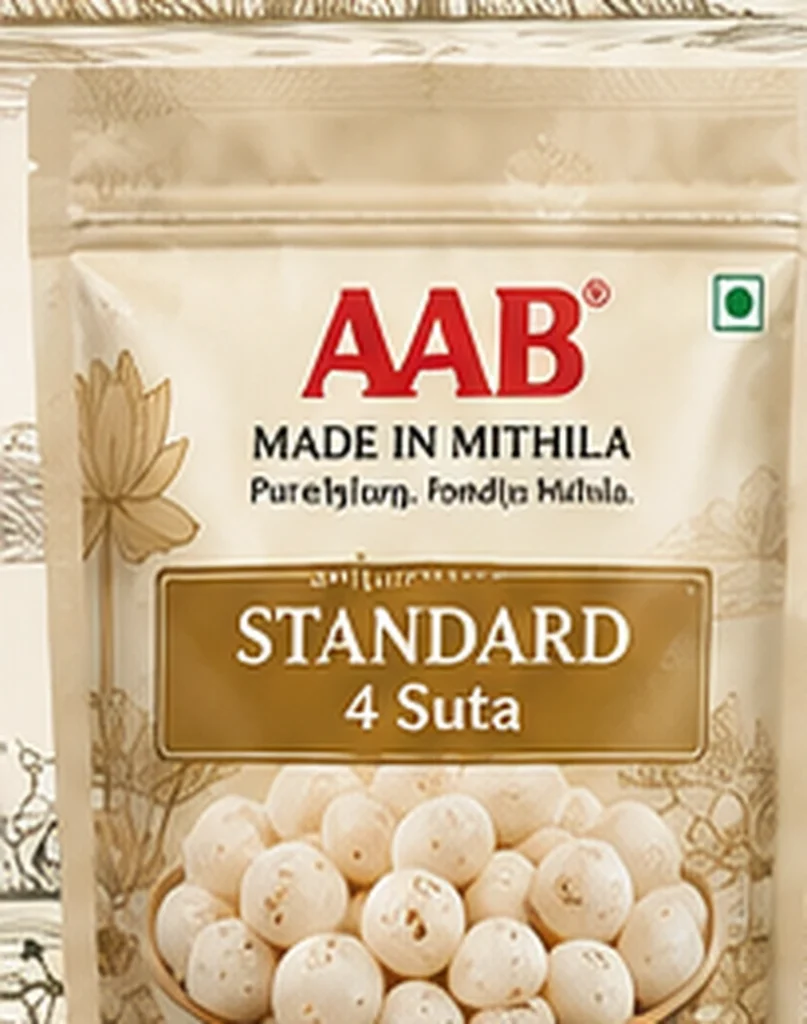
Check the stated Suta grade or retail range and the actual pack weight before comparing prices.
Product and packing details
Review the product description, current photograph, packing charge and delivery charge shown for the order.
Seller and policy information
Use the business contact, checkout, delivery and return information published by the seller. The National Makhana Board is not a substitute for checking the seller’s own commercial terms.
What wholesale and B2B buyers should define before ordering
A practical wholesale requirement should state the exact grade, total kilograms, packing format, destination and required timeline. Price per kilogram can change with total quantity, and packing plus carrier delivery should be reviewed separately so the commercial cost is clear.
Open MadeInMithila Wholesale / B2B Understand Makhana Grades
National Makhana Board and the Mithila Makhana GI are different
“Mithila Makhana” is also a registered Geographical Indication (GI), application number 696. The GI certificate was issued on 16 August 2022 and the current registration record is valid up to 13 August 2030. The GI registration and the National Makhana Board are separate frameworks. Buyers should not treat the existence of the Board as proof that a particular seller or product has any separate GI-user authorization.
Official sources and current references
PIB — First meeting and scheme priorities (Dec 2025)
PIB — Scheme budgets and 2025–26 production update
IP India — Mithila Makhana GI registration details
Shop or source makhana from MadeInMithila
Retail customers can compare current MadeInMithila consumer packs, while approved business buyers can use the separate wholesale portal for grade-based buying and B2B terms.
Shop Retail Makhana Wholesale / B2B
Information note: Government schemes, annual allocations and implementation details can change. Use the linked official sources for the latest programme rules and eligibility information.